Sound Reinforcement Behind the Scenes at Blizzcon

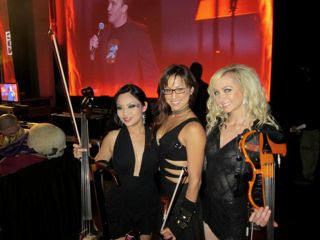
Christine Wu and Band on stage at Blizzcon 2010I don’t often get a chance to talk about my secret passion for World of Warcraft (a massively popular online game) here at AudioWorld. So I was quite pleased to find this opportunity! Electric violinist Christine Wu has posted a great story about the technical challenges she faced with sound reinforcement when she performed as bandleader at last October’s Blizzcon 2010 event.

Blizzcon is a huge annual event put on by Blizzard Entertainment, the game developer responsible for World of Warcraft, in Anaheim, California. It’s the place to be for WoW gamers, and it always includes splashy concert events in the evening, at Anaheim Convention Center. For Blizzcon 2010, one of the main stage events featured a costumed, WoW-themed dance contest, with music provided by a very hot band of L.A. session players, fronted by three electric string players. All led by Christine Wu.

The show came off without a hitch, at least as far as I could tell at the time. I remember thinking what a great job the band did, sounding (and looking) great under difficult circumstances. As Christine puts it… “we have no idea if we’ll play 10 seconds or 2 minutes of each song… but I’ll have no feed from the show’s producers or a talkback mic to talk to my band, which is going to present a MAJOR challenge.”

That turned out to be almost the least of her problems. Her story of behind-the-scenes at the show details how she used an Apogee GiO guitar interface to hook up her custom 5-string Yamaha electric violin with her Mac laptop, Logic Audio, and Waves GTR and Pedalboard. This solved all kinds of trouble with software incompatibilities and audio connectivity, and she managed to run solid through a 3-hour show entirely on battery power.

It’s a great story, especially for those of us who were at Blizzcon and enjoyed the whole spectacle without ever thinking what was going on with audio. In fact, I remember overhearing several comments about how great the sound was, better than ever before at a Blizzcon event.

Gratz to Christine Wu, her band, the sound reinforcement crew at Blizzcon… and Apogee Digital for the versatile GiO interface.

Native Instruments Releases a Slew of New and Updated Software with a Massive Deal

The latest round of software instrument updates from virtual instrument maker Native Instruments (NI) includes upgraded versions of Battery (drums and percussion), FM8 (fm synthesis), Absynth (modular synth), and Komplete (big software bundle), along with the brand new Massive wave-scanning synth.

The best news for completists who want to own everything NI makes is a limited time offer: buy Komplete 4, along with the Kore hardware/software bundle, and you get a free copy of Massive (special deal runs until December 31st 2006).

Native Instruments says that Massive ($339 US) uses a new high-resolution audio engine, and combines advanced Wave-Scanning synthesis with a wealth of sophisticated sound-shaping and modulation options.

The result: a charismatic high-end sound full of warmth, punch, character and definition. Massive is “a true next-generation software synthesizer with unique sonic character, outstanding audio fidelity, vast flexibility and an innovative, highly accessible interface.”

Absynth 4 ($339 US) is the 4th generation of NI’s award-winning semi-modular software synthesizer. Absynth is well-known for its unique evolving sounds and textures. The new version offers a new customizable signal flow that allows for extended sound design and performance capabilities.

It also brings additional oscillator, waveform and envelope features, and a completely revised modulation concept. Native Instruments also points out numerous usability improvements, including a new KORE-compatible sound browser, that will provide a more convenient creative workflow.

FM8 ($339 US) is the long-awaited successor to the popular FM7 software synthesizer, which has become a classic in its own time as a deluxe emulation of the Yamaha DX-7 synthesis architecture. The new FM8 comes with an enhanced high-resolution audio engine, intelligent sound morphing, added performance features and a new KORE-compatible preset manager.

“The FM8 makes the timeless and highly expressive musical potential of FM synthesis available in a thoroughly modernized instrument that fits perfectly into today’s studio and stage setups,” says Native Instruments.

Battery 3 ($229 US) offers a significant revision of the popular drum and percussion sampler. New features include time-stretching and advanced loop capabilities, innovative “play parameters,” a powerful master effects section and an integrated wave editor. Battery 3 also comes with an enormous library of more than 100 high-quality drum kits providing a wealth of studio-quality material for all styles and genres.

Last, and by no means least, Komplete 4 ($1,499 US) is the new version of the powerful software bundle that has become a mainstay with professional musicians and producers around the world. With a universal selection of state-of-the-art instruments and effects, reinforced through several powerful updates to some of its key components, Komplete 4 continues to mark the cutting edge in software synthesis and to provide an invaluable resource for all areas of modern music production and performance.

Native Instruments Website (U.S.)

Tascam’s New DM-4800 Digital Console Is Perfect for the Computer-Based Professional Studio

Tascam’s new DM-4800 ($5,999 US) digital mixing console, launched this week at the AES convention in San Francisco, is designed to integrate with a computer-based DAW.

The DM-4800 provides 48 channels and 16 returns for a total of 64 inputs. Also onboard are 24 analog mic/line inputs with phantom power for condenser mics and analog inserts. Users can add mic preamps by using expansion cards with external preamps. Four expansion card slots support optional FireWire, ADAT, AES/EBU, Analog, TDIF and Surround Monitoring cards.

Tascam says that the DM-4800 feature list offers mixing specs that equal or surpass digital consoles over twice its price. The company positions the DM-4800 as a digital console for professional users who demand a flexible, 64-channel mix platform that can be configured to fit their needs, especially in a computer-based environment.

A “fat channel” strip in the center of the board provides instant access to 4-band parametric EQ, dynamics and auxiliary controls available for the first 48 channels. Twenty-four studio-grade mic preamps provide enough inputs for a live event, and more can be added using expansion cards with external preamps. The standard compliment of analog and digital I/O is more than you’ll find on consoles costing three times as much, and a completely configurable 24-buss routing system allows you to re-patch the board at the flick of a switch.

TASCAM’s DM-4800 fits seamlessly into the modern recording environment based around a computer DAW. With a single button press, the Remote layer provides a 24-fader control surface for control of premiere workstations such as Pro Tools, Logic, SONAR, DP, Cubase and Nuendo.

Options available for the DM-4800 digital mixer include the IF-FW/DMmkII FireWire interface card, which provides 32 channels to and from a computer at up to 96kHz over a single FireWire cable; and a surround monitoring card that provides down-mixing, bass management and level control for mixing in up to 6.1 surround.

More features:

  • 48 channels and 16 returns for 64 total inputs
  • 24 busses
  • 12 Aux Sends
  • 24 mic/line inputs with analog inserts and phantom power for condenser mics
  • 24 channels of TDIF and 8 channels of ADAT built in
  • 4 expansion card slots support optional FireWire, ADAT, AES/EBU, Analog, TDIF and Surround Monitoring cards
  • Dedicated cascade port -supports cascade of two DM-4800s
  • Channel Strip section for EQ, Dynamics and Aux control of selected channel
  • Per channel LED ring encoders for pan, aux sends and EQ
  • Built-in DAW control layer compatible with Pro Tools®, Logic Pro™, SONAR™, Cubase™, Nuendo™, and Digital Performer™
  • Transport buttons control DAW software or RS-422 devices
  • Powerful automation with touch-sensitive motorized faders
  • 4-band EQ, compression and gating on each channel
  • Compression for each aux, buss and main output
  • Two built-in effects processors, each able to run TC Reverb programs
  • Flexible routing allows any input to be routed to any channel or output
  • Offload data to convenient Compact Flash media using built-in CF slot
  • Optional MU-1000 meter bridge
  • Stylish, professional design with rear panel I/O connections

Neyrinck Audio Updates Soundcode Plug-Ins for ProTools, Adding DTS Surround Encode and Decode

Neyrinck Audio has begun delivering its new SoundCode for DTS plug-in suite for Digidesign® Pro Tools systems to pro audio dealers. List price is $995 (US).

SoundCode for DTS is the newest addition to the Neyrinck SoundCode product family of professional surround sound encoder/decoders. The line first appeared in 2005 with the release of the SoundCode for Dolby Digital plug-in.

The SoundCode for DTS plug-in suite is tightly integrated with Pro Tools software. It provides mastering-quality workflow tools that enable encoding and decoding of DTS Digital Surround, 96/24, and ES audio directly within Pro Tools HD, Pro Tools LE, and Pro Tools M-Powered systems.

“SoundCode for DTS is a must–have for post production professionals delivering high-quality audio for DVD-Video and DVD-Audio,” comments Paul Neyrinck.

Neyrinck Audio's SoundCode for DTS Encoder Plug-In

The SoundCode for DTS Encoder, which operates as an AudioSuite™ plug-in, offers a faster-than-real-time way to encode audio from a Pro Tools session – ready for use with DVD audio and video authoring applications. The time-saving Punch In/Out encoding feature allows users to punch in fixes to an existing DTS file. If the audio for a two-hour program has already been encoded, but a single line of dialog needs to be replaced, SoundCode can encode just that line, without having to re-encode the entire two-hour soundtrack. In addition to DTS 5.1 Digital Surround, DTS 6.1ES Discrete mode can be used to encode a rear center channel for increased surround localization and spatialization. DTS 96/24 mode can be used to encode 96 kHz, 24-bit audio up to 5.1 channels for applications requiring the highest fidelity possible.

The SoundCode for DTS Decoder functions as a real-time RTAS® plug-in or a non-real-time AudioSuite plug-in. The real-time decoder features Sample-Accurate Direct File Decode to decode a DTS file in real-time synchronized to the Pro Tools timeline and video. Simply point SoundCode to the DTS file and press play for mastering-quality confidence monitoring. The decoder also features a legacy monitor so a user can hear how 96/24, 5.1 ES, and 6.1 ES streams will decode on a legacy 5.1, 48 kHz system. Using the AudioSuite decoder, users can decode all or a portion of an audio file faster than real time, or view the metadata of a DTS file.

SoundCode for DTS is compatible with Pro Tools LE and M-Powered systems so that low-cost encoding/decoding workstations can be configured in post production and DVD authoring facilities. The fully functional encoder can encode a surround mix from a set of imported mono tracks. The decoder stereo can output a DTS bitstream over SPDIF to an external home theater decoder for surround monitoring.

Neyrinck Audio

Native Instruments and Stanton Team Up to Create Integrated Hardware/Software Bundle Around New Version of Traktor DJ Studio

Software instrument developer Native Instruments has announced a new version of its Traktor DJ Studio software, and plans to penetrate the professional DJ market through closer collaboration with Stanton Magnetics.

The version 2.6 update fuses two of the most advanced digital DJ platforms into one complete solution: Traktor DJ Studio is now fully compatible with the latest version of Stanton’s vinyl-controlled DJ system, FinalScratch 2.

The update to version 2.6 will be available in November 2004 as a free update for all registered users of TRAKTOR DJ STUDIO 2.5.

Stanton will bundle the FinalScratch 2 System, consisting of Traktor DJ Studio, the FinalScratch 2 controller, and a new Firewire sound card called ScratchAmp 2. Stanton will also ensure that the software is positioned right at the heart of the DJ market by taking over worldwide distribution of Traktor DJ Studio.

“Traktor DJ Studio’s integration with FinalScratch 2 makes for a complete Digital DJing package that is hard to beat,” says Daniel Haver, CEO of Native Instruments.

“Since both products have grown so close now, we are very happy to have Stanton leverage their longstanding experience in the DJ market to distribute Traktor DJ Studio and FinalScratch alongside each other in the future.”

Traktor DJ Studio 2.6 offers several new features: live broadcasting via Internet, live audio input with on-the-fly audio recording, a revised filter section, added support for WMA and AAC audio files, along with several other enhancements.

New features in Traktor DJ Studio 2.6 include:

* Compatible with FinalScratch 2 – Traktor DJ Studio now works together with Stanton’s FinalScratch 2 hardware, which makes the software fully controllable via turntables and DJ CD players
* Internet Broadcasting – your performance can be streamed live over the Internet, thanks to integrated support for the Icecast streaming server protocol
* Live Input / Live recording – an external audio signal can be integrated live into the mix via a third dedicated mixer channel, which allows for announcements, voice-overs, MCing and much more: the input signal can even be recorded on-the-fly, and the recordings can be dragged directly into the mix
* Mix Recording – the mix can now be directly recorded into an audio file on hard disc during the performance, as an alternative to the existing non-destructive mix recording method
* Enhanced Filter Section – Traktor DJ Studio now offers a revised filter section which is sonically optimized for the treatment of full audio tracks
* Support for AAC and WMA – Traktor DJ Studio now also plays tracks in AAC format (Apple iTunes, non-DRM files only) as well as in WMA format (Windows Media Player)
* Browser Favourites – the file browser now offers a special “favourites” section where up to 12 selected folders or playlists can be stored, which can then instantly be accessed via keyboard shortcuts
* Playlist History – a new history function gives a detailed overview about all recently played tracks, and the list can also be printed out or exported – especially useful for professional DJs who have to take care of license payments to copyright associations

Traktor DJ Studio is the most powerful and versatile software solution for professional DJ mixing, live remixing and mix recording using tracks in MP3, WAV, AIFF, and audio CD format. It exceeds the possibilities of traditional DJ equipment by implementing a vast range of mixing features that only software can provide. This includes graphic waveform displays, tempo recognition and automatic synchronization, real-time time stretching, up to 10 cue points and 10 tempo-precise loops per track, and a track database with ultra fast search function.

Key features of Traktor DJ Studio carried over from previous versions include:

Displays
The tracks are graphically shown as waveform displaying the sound in two frequency bands for visual control of beats, breaks and instrumentation. An additional display now shows the entire track for fast navigation.

Tempo Detection
TRAKTOR DJ Studio’s tempo detection uses complex algorithms for reliable beat alignment of two tracks on the fly. Tempo reading for complex beats can be improved by additional user tapping.

Tempo Correction
Pitch tracks +/- 100% or change their tempo in real-time using true-to-sound time stretching.

Precise Cue-Points and Loops
Up to ten available cue-points and loops per track open new dimensions for accurate cueing and live remixing. Cue points can be beat-quantized, loops can be set accurately on the bar, resized, moved, all without losing the groove.

Filters and Equalizers
High-end filters and equalizers radically transform the sound of the tracks.

Track Database
The easy-to-use track database provides a comfortable tree navigator, powerful quick search, MP3 browser, MP3 browser, automatic playlist icons keeping track of the set and direct pre-listening of tracks.

Automation and Mix Export
Full automation of functions and actions, recording of all user actions, seamlessly resuming mixing sessions, editing, overdubbing and exporting the entire mix as WAV or AIFF files.

Total Control
All of TRAKTOR’s over 400 functions and actions can be operated by mouse, user programmed keyboard shortcuts, MIDI controllers or MIDI note events. Comprehensive learning functions provide straightforward allocation of external equipment. In addition TRAKTOR DJ Studio 2.5 can be synced with other music programs via OSC or MIDI clock.

Native Instruments Web Site

Stanton Magnetics Web Site